The 3 Languages of Sales

Three mysteries. One explanation.

The room that said no when everything was right. The phone that weighs forty pounds on a Monday morning. The rare career that compounds while the others churn.

The Three Mysteries

What product, price, and positioning do not explain.

I.

The room

Part One of the book

Everything was right. The rep knew the product cold, the price was where it needed to be, and the offer was positioned with precision. The answer was still no. And in another room, with everything wrong, the paper got signed.

“You have closed with two of the three wrong. You have lost with all three right.”

II.

The phone

Part Two of the book

Two reps with the same training, the same products, and the same quota walk toward the same phone on the same Monday morning. One of them sings while the other one sighs.

The resistance at issue is the one activity targets do not explain: the capable rep who works hard everywhere except the phone.

III.

The years

Part Three of the book

The rep a sales leader loses sleep over losing. The calendar is always full, the rooms keep saying yes, and the book of business compounds instead of resetting every January.

The pattern is easy to recognize and harder to explain. What cannot be explained cannot be trained.

The second evaluation

Sales has a familiar visible trinity: product, price, and positioning. They shape how deals are prepared, compared, and autopsied after the fact, and they matter. That is the first evaluation, and a buyer can discuss it out loud.

The second evaluation runs underneath it. It is not simply about what is being sold. It is about whether the way the decision is being presented matches the way the buyer is trying to make sense of it: whether the rep is reaching what matters in the decision, or repeatedly talking past it.

“Passing the first evaluation does not mean you have passed the sale. A deal can be right on product, price, and positioning and still die in the second evaluation.”The 3 Languages of Sales

A failed second evaluation is read from live evidence in the room, not inferred backward from the final no. The buyer often cannot name it, and hands over the closest phrase available: “I want to think about it.” “Send me something.” Sometimes those words mean exactly what they say. When they do not, they are a lead to investigate, not proof of what happened underneath.

The Three Languages in a Sales Room

What is on the client’s mind.

Each language tells you what the second evaluation must be built from. Every person speaks all three; the work is to read which one is carrying this decision, and test the read.

I.

Truth

Structure · Logic · Evidence

“Can I trace this from A to B?”

The questions are not stalling. They are how the Truth speaker builds the foundation needed before buying.

When the model holds, the client can move. When the structure breaks, the close can break with it.

II.

Goodness

Relationship · Character · Care

“Who does this touch, and can I trust you with them?”

Goodness weighs responsibility and relationship: who is protected, what conduct is required, and who bears the consequence.

When the client feels seen, the decision can move. When the client feels processed, the client leaves.

III.

Beauty

Meaning · Vision · Story

“What does this become, and is it worth becoming?”

Beauty tests the picture: what the decision becomes inside the larger story.

When the client can see life on the other side of yes, the decision can move toward it. Without the picture, data and warmth cannot supply what is missing.

“This is a field framework, not a personality system. You do not type a client and protect the label. You make a read and test it.”The 3 Languages of Sales

The Napkin

Misalignment. The pivot. Alignment.

A horizontal line: the conversation the rep is trying to have with the client. The rep’s half circle sits below it, opening upward. The client’s sits above, opening in the direction of the client’s language.
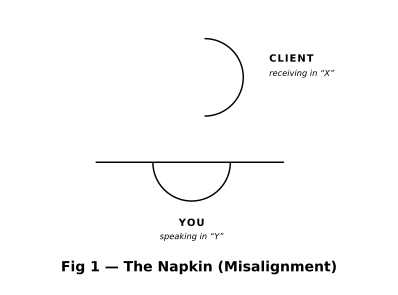
The Napkin: two half circles that do not face each other across the line of the conversation
Misalignment. The two half circles are not facing each other. The circle stays open, and the second evaluation works against the deal.
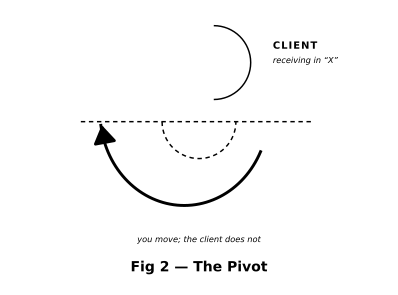
The Pivot: the seller moves around the line to face the client's half circle
The pivot. Treat the client’s half circle as fixed. The rep’s job is not to turn the client. It is to move, until what the rep sees is what the client sees.
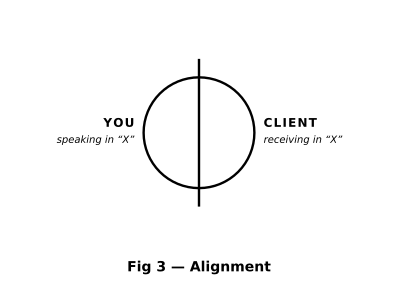
Alignment: both half circles face each other across the line and the circle closes
Alignment. The circle closes. The second evaluation is no longer working against a deal that can otherwise stand.

Rule 1. Close the circle, close the deal.

Rule 2. The client never pivots. You do. Always.

Closing the circle does not replace the first evaluation. It does not rescue a bad product, erase a bad price, or make an impossible road real. And clearer perception is not permission to manufacture persuasion.
i.
The 3 Languages of Sales — book cover

The Book

The 3 Languages of Sales: Why Buyers Say Yes, Why They Walk Away, and How to Hear What They’re Really Telling You. Three parts, one per mystery.

Get the Book

Part OneClose the Circle, Close the Deal

The room. The three languages, how to hear one in the first five minutes of small talk, and how to move so that the client’s half circle and yours close into one. Part One ends with the diagnostic a rep can run in the very next client meeting.

Part TwoThe Reps Who Make the Calls and Why You (Probably) Can’t

The rep. The same framework, turned around and aimed at the chair on the seller’s side of the table. It names what has been quietly deciding the calendar, and what is needed to pick up the phone on Monday.

Part ThreeThe Absolutely, Positively, Unpoachable Sales Rep

The years. The architecture that can turn closed deals into the Tuesday afternoon call: the client who phones years later, not shopping and not comparing, calling the person they call when something changes. Its final chapter hands the sales leader the instrument the dashboard was missing.

ii.

Reading the book?

If you already have The 3 Languages of Sales in hand, these are the next steps that exist today.

Review the framework

The three languages, the wider door, Mirrored Reception, and the Napkin figures, set out on one page.

The 3 Languages Framework →

Bring it to your team

The 3 Languages Workshop is hands-on learning, applied to your team’s actual work, built on the book.

The 3 Languages Workshop →

Ask a question

Tell us what you are working on, or ask about bulk and corporate orders of the book.

Contact us →

You are not going to learn to change anyone. You are going to learn to see what was already there.
— The 3 Languages of Sales
Bring The 3 Languages Workshop to Your Organization